FORTRESS at DAC 2026 with a modular RISC-V extension for post-quantum cryptography
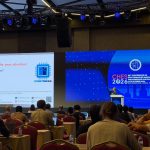
At the 63rd Design Automation Conference (DAC 2026), held from 26 to 29 July 2026 in Long Beach, California, USA, the paper “Raise the Shields: A Modular RISC-V Extension for Post Quantum Cryptography” was presented. The work is the result of a collaboration between Politecnico di Torino and #FORTRESS partner #UniBwM (University of the Bundeswehr Munich).
Post-quantum cryptography replaces today’s public-key algorithms, which a sufficiently powerful quantum computer could break. The new algorithms are demanding for small processors: instead of a few operations on very large numbers, they perform a very large number of small operations, such as hashing, random sampling and polynomial arithmetic. Running them purely in software is limited by the performance and energy constraints of general-purpose processors, while the most compact hardware accelerators typically support only a single algorithm.
To address this challenge, the paper proposes a compact set of custom instructions for the open RISC-V processor architecture. They are executed by a small coprocessor that is attached through a standard extension interface (CV-X-IF), so the processor core itself does not have to be modified. The instructions accelerate the operations that many post-quantum schemes have in common: Keccak hashing, random sampling, modular and polynomial arithmetic, finite-field operations and coefficient compression. In this way, one design supports the NIST-selected algorithms ML-KEM, ML-DSA, SLH-DSA and HQC, as well as further schemes such as Falcon, CROSS and LESS. Evaluated for a 65 nm chip technology, the coprocessor occupies 26.3 kGE, less than 2% of the total system-on-chip area. On average, the new instructions are about 5 times faster than pure software execution, and more than 200 times faster for one specific operation (Karatsuba multiplication), with substantial energy savings.
The design is modular: new cryptographic operations can be added with minimal hardware changes, which supports crypto-agility. This is in line with the FORTRESS goal of a flexible Root of Trust that integrates both traditional and post-quantum algorithms. The complete hardware and software are available as open source, and the paper is open access at https://doi.org/10.1145/3770743.3804373